|Articles|October 2, 2015
- BioPharm International-10-15-2015
- Volume 2015 eBook
- Issue 2
Cleaning Validation for Biologics
Author(s)Andrew Walsh
Can alternative approaches to the permitted/acceptable daily exposure be justified?
Advertisement
BioPharm International
eBooks Volume 28, Issue 14
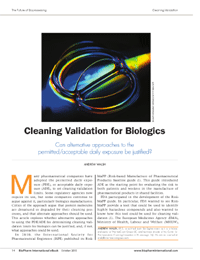
Many pharmaceutical companies have adopted the permitted daily exposure (PDE), or acceptable daily exposure (ADE), to set cleaning validation limits. Some regulatory agencies now require its use, but some companies continue to argue against it, particularly biologics manufacturers. Critics of the approach argue that protein molecules are denatured or degraded by their cleaning processes, and that alternate approaches should be used. Read this article and other articles in
BioPharm International
's 2015
eBook.
Articles in this issue
about 11 years ago
Fluctuating Capacity and Demand Conditions in Biomanufacturingabout 11 years ago
Automation of Single-Use Systemsabout 11 years ago
Are Biopharma Patents Poised on the Post-Grant Chopping Block?about 11 years ago
Raising the Bar for Biopharma TrainingAdvertisement

Related to this article

LumaLex Law's Dustin Robinson explains why retatrutide compounding remains illegal regardless of the Seventh Circuit's pending classification ruling.

Artiva Biotherapeutics will present data on AlloNK, an allogeneic, non-genetically modified NK cell therapy given with rituximab, in refractory rheumatoid arthritis, Sjögren disease and systemic sclerosis at ACR Convergence 2026, ahead of a planned phase 3 trial in rheumatoid arthritis.

Novartis has secured an exclusive worldwide license to ABO2203, Abogen's investigational mRNA-encoded CD19xCD3 T-cell engager designed to produce the bispecific inside the body to reset B cells in autoimmune disease. The agreement also includes options on other programs built on Abogen's RNA platform.

The 15-month project could let living cell therapies ship and store at room temperature, cutting cold-chain costs that limit patient access.

A planned phase 3 trial will test the TROP2 ADC and PD-1/VEGF bispecific together in 1st-line triple-negative breast cancer.

Former FDA oncology reviewer Paz Vellanki, MD, PhD, of Precision for Medicine, discusses how CDER's ARC program supports novel end points such as ctDNA for rare diseases and why sponsors should engage FDA early.

Following an FDA meeting, Wave Life Sciences plans a single 2-year registrational trial of WVE-006, its GalNAc-conjugated RNA editing oligonucleotide for alpha-1 antitrypsin deficiency, with a 1-year interim analysis that could support accelerated approval based on biomarkers.
Advertisement
Advertisement